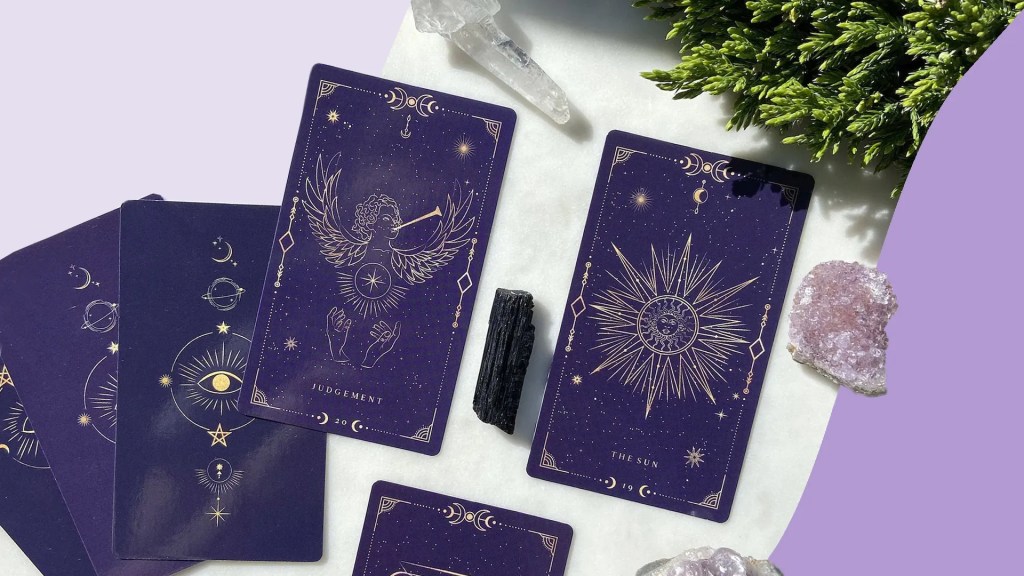
Let’s talk TAROT…
Reading Tarot involves a combination of using your conscious desire to search for truth, meaning and purpose alongside your ability to listen to and interpret the voice of your unconscious, which finds its mirror image in the cards. Learning to read the cards in a mindful manner is a lesson in channeling emotions. How we choose to react to what life deals us is everything.
When you see the cards and hold them in your hands, you are holding the events of your life within these cards. The symbolic understanding of the tarot is key to experiencing it’s power. Think of this as a conversation with yourself and your inner world.
I recommend finding yourself a deck that you resonate with and getting into the habit of shuffling the deck, and doing readings. The deck usually comes with a book to help you interpret each card – eventually you’ll want to work up your ability so that you don’t need to reference that book anymore.
The trick is to learn the symbols and what they mean in relation to the person you are reading, and what they have asked you to read for them.
I recommend keeping a Tarot journal. You can find preprinted books on amazon that will help provide guidance and structure as you get started. I’ve included a second PDF that contains a page from a tarot journal I have been using. I hope it helps you get your own journal started.
The Major Arcana
The Conscious – body, social, external, outer concerns, youth, personal. This stage looks at material concerns that affect our worldly lives.
The Unconscious – mind, moral, internal, inward search, adulthood, collective. This stage focuses on one’s inner world and search for identity.
The Superconscious – emotional, hidden, maturity, divine, universal, spiritual awareness. This stage deals with the Fool’s experiences as they develop awareness of their role and place within the greater universe.
Learn to connect with the eternal and universal forces of the psyche.
See the PDF below for details on which cards in the Major Arcana fall under each section.
The Minor Arcana and Numerology
Referring to the Ace through Ten cards, these generally concern mundane matters in the course of one’s life, aspects of the self or literal people in one’s life.
See the PDF below for details on what each number card represents.
The Suits and the Elements
Just like there are four elements, there are four suits in the Tarot. Wands, Cups, Swords, and Pentacles. These represent Fire, Water, Air and Earth respectively.
See the PDF below for details on what each suit’s elemental affiliation means.
The Court Cards
Based on universal archetypes whose reflections we can see within the family unit.
See the PDF below for details on what each court card means.
Reversals
If you get a reverse card you dislike, dont be afraid to work with it and explore how to shift your take on it in your readings. Consider what it means for the reversed card to become upright again, what you need to do in order to remove the blockage or create balance.
When you change the card to its upright position with your hands, feel whatever is represented by that spread position flow more openly and correct itself.
This is the power of ritual and symbolic action – to trust that a movement of your hands also shapes the outline of your life. You can willingly alter the course you are reading.
Uncover the patterns and structure behind the tarot and you will get a holistic and overarching vision of the self. Discover ways to develop your ability to connect with your unconscious through readings you conduct.
Tips on how you can interpret them in a healthier way. Ideally we can learn not to avoid perceived negativity, but face these cards with openness and courage.
Light and Shadow: each card is an archetype and it holds both a light and a shadow
Symbols, not omens: see the cards as a tool that gives a voice to our inner world. The cards can help you practice thinking about things in a symbolic way.
A larger story: each card is a part of a larger tale and the wheel always turns
Reframe negative cards: consider card reversals as an opportunity to find areas of improvement
Which interpretation?
You will have to use your story telling abilities, your intuition, and the readings context to better understand which meanings are applicable. Different methods of reversal interpretation can sometimes give the same results
I’ll let you take it from here and go find your resources to begin to learn. I suggest keeping a tarot journal to document your readings and to begin doing readings daily or weekly – whatever fits your schedule, but the more time you spend looking at the symbols in your chosen deck, the more you read it, the more it binds to you, and the easier reading tarot will become. The deck will absorb your energies as you work with it and you’ll find in time that your readings become more and more accurate.
Please feel free to download this 3 page PDF
Recommended Reading
I would HIGHLY recommend finding a copy of Tarot: Connect with yourself, develop your intuition, live mindfully by Tina Gong
Not only does this book give a FANTASTIC primer but it gives in depth descriptions and interpretations of each card. Its a fantastic reference and I keep it close at hand. It’s also got a bunch of tarot spreads you can try and use as well as clarifies what each position in each spread represents. Like I said, it’s a fantastic reference to have on hand when you work with Tarot.
As mentioned above, here’s a second PDF page for you – this is a scan of one of the pages in the 100 Days 3 Card Tarot Spread Notebook Journal I have. I hope it helps you.

Leave a comment